

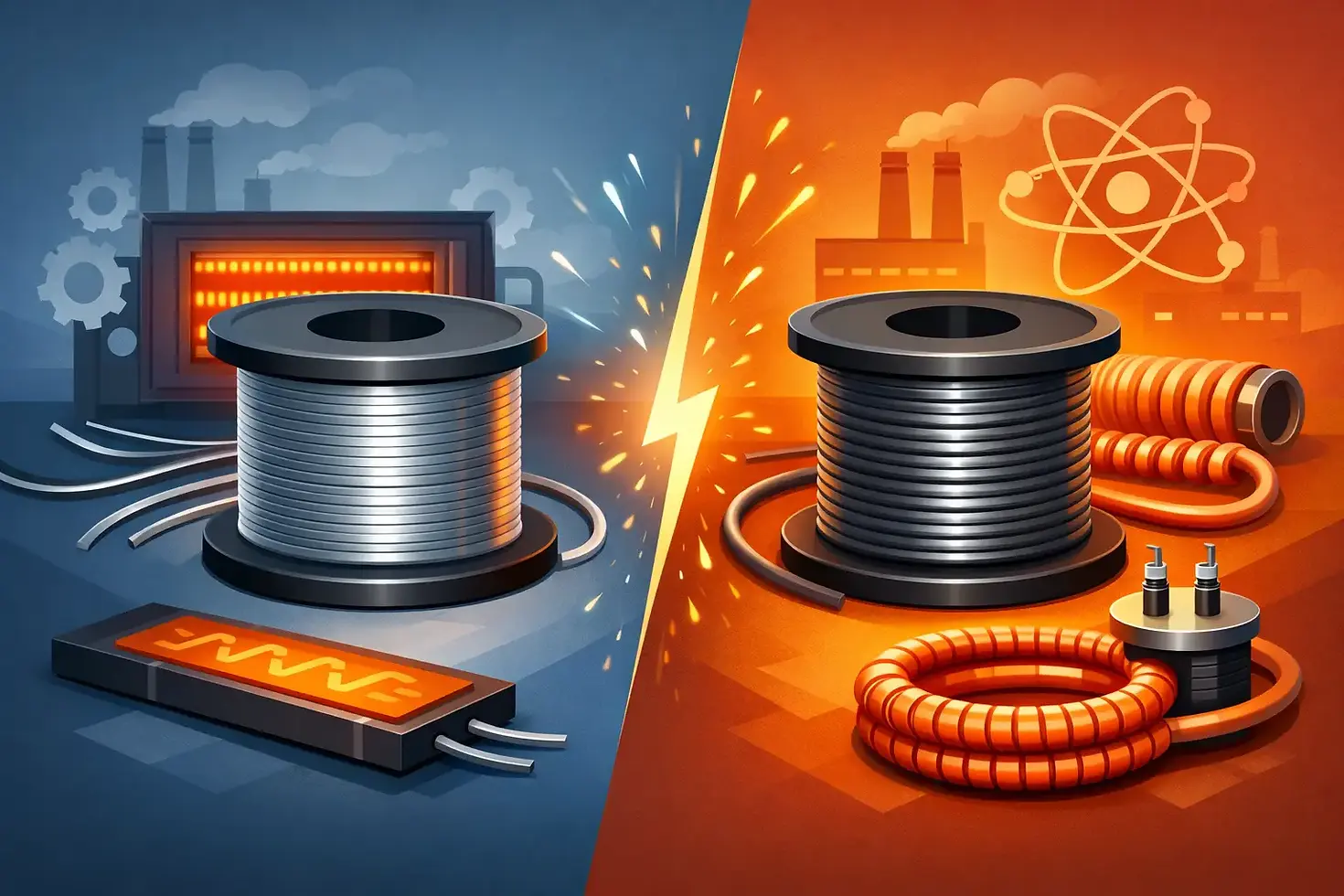
Kanthal vs Nichrome Wire for Industrial Heaters
- Terence Sia

- Aug 2
- 6 min read
A heater element can look acceptable on a drawing yet become the weak point in a furnace after a few production cycles. The choice between Kanthal vs Nichrome wire affects more than wattage. It influences maximum operating temperature, coil geometry, oxide formation, service life, replacement frequency, and ultimately the risk of unplanned downtime.
For industrial heating equipment, neither alloy is automatically the better choice. Kanthal FeCrAl wire is often selected where high temperature capability and oxidation resistance are decisive. Nichrome wire remains a highly practical material where mechanical strength, ductility, and stable performance at moderate-to-high temperatures matter most. The correct decision starts with the actual thermal environment, not the alloy name on a previous bill of materials.
Kanthal vs Nichrome Wire: The Material Difference
Kanthal is commonly used as a general name for iron-chromium-aluminum, or FeCrAl, resistance alloys. In service, the aluminum in the alloy forms a dense aluminum oxide layer on the wire surface. This oxide layer protects the underlying material from further oxidation when the element operates in a suitable oxidizing atmosphere.
Nichrome refers to nickel-chromium resistance alloys, often containing iron as well. Its protective surface layer is principally chromium oxide. Nichrome has been a long-standing choice for resistance heating because it offers dependable electrical resistance, good formability, and good mechanical behavior during fabrication and thermal cycling.
The difference in base metallurgy drives the practical trade-off. FeCrAl materials generally provide higher maximum element temperatures and higher electrical resistivity. Nickel-chromium materials generally retain better ductility and mechanical toughness after heating. A replacement element therefore should not be specified by wire diameter alone. Alloy grade, resistance per unit length, winding pitch, support arrangement, power loading, and operating atmosphere all need to align.
Where Kanthal Wire Has the Advantage
Kanthal FeCrAl wire is frequently the preferred material for high-temperature air-heating applications. Depending on the specific grade, element design, and installation conditions, FeCrAl elements can operate at element temperatures approaching 1,300°C. This makes them well suited to electric furnaces, ceramic kilns, heat-treatment equipment, and other applications where the chamber temperature and element surface temperature are both demanding.
Its higher electrical resistivity is another practical advantage. For a given electrical resistance, Kanthal can often use a shorter wire length or a smaller cross-section than a comparable Nichrome design. This can help when there is limited space inside a furnace chamber, on a ceramic support, or within a compact heating module.
The aluminum oxide scale formed by FeCrAl is also highly protective in clean, dry, oxidizing conditions. Once properly established, it supports long element life under sustained high-temperature operation. For furnace operators, this can translate into fewer element changes and more stable production intervals, provided the system is designed to avoid localized overheating.
Kanthal is particularly effective in applications such as batch and continuous heat-treatment furnaces, ceramic firing equipment, radiant heating assemblies, and high-temperature process heaters operating in air. It is also commonly considered where energy efficiency matters, since a well-designed FeCrAl element can provide a high operating temperature with controlled power density.
There is a limitation that maintenance teams should plan for: FeCrAl wire becomes more brittle after extended high-temperature exposure. It should not be repeatedly bent, twisted, or aggressively handled during service work. A coil that has reached end of life may fracture when disturbed, even if it appears intact before removal. Proper element support and careful replacement procedures are essential.
When Nichrome Wire Is the More Practical Choice
Nichrome wire is often the better fit when an element must be formed into tight coils, complex shapes, or repeatedly handled during manufacturing and installation. Its ductility makes it easier to wind and fabricate, while its mechanical strength at elevated temperature can be advantageous in certain element configurations.
Although Nichrome usually has a lower maximum operating temperature than high-grade FeCrAl, it performs very well across a broad range of industrial heating duties. It is commonly used in lower-temperature furnaces, ovens, air heaters, duct heaters, packaging equipment, laboratory equipment, and general-purpose process heating assemblies.
Nichrome can be especially appropriate where frequent thermal cycling occurs at temperatures below the range that demands FeCrAl. An element that sees regular starts and stops is subjected to expansion, contraction, and changing mechanical loads. Coil pitch, mounting method, and terminal design remain critical, but Nichrome's material behavior can provide a useful margin in mechanically demanding assemblies.
For replacement work, Nichrome may also be selected where an existing heater was designed around its resistance characteristics and physical dimensions. Substituting Kanthal without recalculating wire length and loading can alter resistance, heat distribution, and element temperature. A material upgrade on paper can become a reliability problem if the geometry is not redesigned.
Temperature Is Not the Only Selection Criterion
Maximum temperature ratings are useful screening values, but they are not a complete design basis. The temperature that matters most is typically the element temperature, which can be substantially higher than the measured furnace chamber temperature. A coil operating at excessive surface loading may overheat even when the controller indicates that the process is within specification.
Element temperature is influenced by watt density, coil spacing, radiation to the load, airflow, furnace insulation, mounting position, and contamination. A tightly packed coil or a sagging element can create hot spots that shorten service life. Similarly, a furnace with poor circulation may expose one area of an element to much higher temperatures than another.
For this reason, a 1,000°C furnace does not automatically require the same wire grade, diameter, or coil design in every installation. A light-load laboratory furnace, a production heat-treatment furnace, and a radiant-tube assembly may all operate at the same chamber setpoint but impose very different demands on the element.
Atmosphere Can Change the Answer
Both Kanthal and Nichrome depend on a protective oxide layer for long-term performance. Their behavior changes when the process atmosphere does not support that layer. Reducing gases, hydrogen, vacuum conditions, carburizing atmospheres, sulfur-bearing contaminants, halogens, molten salts, and metallic vapors can all affect element life.
FeCrAl is highly effective in many oxidizing furnace environments, but its aluminum oxide scale may not remain protective in every atmosphere. Nichrome is not a universal solution for aggressive environments either. In some processes, neither exposed wire alloy is suitable, and a different heater construction, protective tube, radiant tube, silicon carbide element, molybdenum disilicide element, or specialized material is required.
Process engineers should also consider contamination from the workpiece. Flux residues, zinc, aluminum, lead, sulfur compounds, and other vapors can attack heating elements or alter their oxide layer. If failures occur repeatedly in the same furnace zone, the root cause may be the atmosphere or load chemistry rather than the alloy itself.
Design Details That Determine Element Life
Wire alloy selection should be completed together with the element design. The most reliable heating element is not simply the wire with the highest stated temperature capability. It is the element that runs at an appropriate surface loading, is supported correctly, and matches the electrical supply and process duty cycle.
A sound specification should define the required voltage, total kilowatt rating, phase arrangement, operating and maximum temperature, atmosphere, available installation space, element configuration, and terminal connection method. It should also identify whether the heater runs continuously, cycles frequently, or must recover temperature rapidly after loading.
Ceramic supports deserve particular attention. Unsupported coils can sag as they soften at temperature, narrowing coil pitch and causing short circuits or local hot spots. High-alumina ceramic bobbins, grooved supports, and properly positioned hangers help maintain the designed element geometry. In radiant or furnace applications, the arrangement should also account for thermal expansion so the element is not restrained as it heats.
For maintenance teams, documenting failed-element location and appearance can improve future replacements. A uniform break after long service suggests normal end-of-life behavior. A localized burn-through, heavy scaling, distorted coils, or terminal overheating points to a design, connection, airflow, or contamination issue that should be corrected before a new element is installed.
Lifecycle Cost Matters More Than Wire Price
Kanthal may deliver a longer operating life in a high-temperature oxidizing application, reducing replacement labor and production interruptions. Nichrome may offer lower fabrication difficulty and better mechanical practicality in an application that does not require FeCrAl's temperature ceiling. The lowest initial wire cost is rarely the decisive number when a furnace outage affects throughput, quality, or delivery commitments.
For industrial buyers, the useful comparison is installed lifecycle cost: material cost, fabrication time, energy performance, expected element life, ease of replacement, and the consequence of downtime. A custom element built to the correct alloy, resistance, coil dimensions, and support configuration is often more cost-effective than a nominally compatible off-the-shelf substitute.
Proheat Services supports this selection process with customized heating solutions for demanding furnace and process-heating environments. Matching the element material to the real operating conditions helps avoid premature failures and keeps production equipment available when it is needed most.
The next time an element requires replacement, treat the failed coil as operating data rather than a simple spare-part request. Its alloy, geometry, failure pattern, furnace zone, and process atmosphere can point directly to the heating solution that will last longer in the next production run.


Comments